The Future
PFS – The Future
 |
|
|
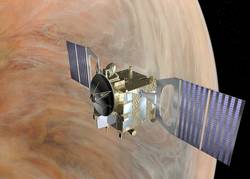
PFS – appearing next on Venus Express
|
A busy time lies ahead for the Planetary Fourier Spectrometer (PFS) team as increasing data accuracy opens up fresh lines of Martian enquiry. Another version of the instrument has been launched on board ESA’s Venus Express mission – and possibly a third PFS is set to orbit Earth.
PFS has been designed so that its signal to noise ratio increases with the total number of measurements made, giving a progressively more accurate representation of Mars.
"In terms of CO2, the combinations you can have are carbon 12, 13 or 14, and oxygen 16, 17 or 18," Formisano said. "The actual isotopic composition we find may have a bearing on the history of the Martian atmosphere. And life on Earth discriminates against heavy isotopes, so if life on Mars is present underground then it may be having an effect on the atmosphere."
Down on the surface, PFS data have been used to estimate surface pressure and altimetry – for example following the slopes of the Olympus Mons volcano up to its 25-kilometre summit, and tracing how surface temperature, pressure and wind fields relate to height. Intriguing anomalies have been detected in the observed temperature against that predicted from elevation and sun angle. Possibly due to dust clouds or differing thermal inertia in the soil, it is another subject due for further investigation.
 |
|
|
Vittorio Formisano
|
The top of the atmosphere is another planned area of enquiry. PFS mostly performs downward ‘nadir sounding’ measurements, but it also has the ability to carry out sideways ‘limb sounding’ observations, to monitor the stratified atmosphere to more than 100 kilometres in height.
|
"If this goes ahead we would especially like to measure the thermal radiation of the atmosphere to compare it against measurements done thirty years ago," Formisano added. |
Such a view should augment the instrument’s ability to investigate so-called non-local thermodynamical equilibrium (non-LTE), where molecules of the upper atmosphere are excited energetically by solar particles – an occurrence of special interest because it is also observed in the corona of stars.
In addition, ESA has agreed in principle to fly a third PFS – a flight model spare – up to the International Space Station, enabling comparative studies of the atmosphere across all three Earth-like worlds.
"If this goes ahead we would especially like to measure the thermal radiation of the atmosphere to compare it against measurements done thirty years ago," Formisano added. "That way we could assess in a very direct way whether heating is taking place."