PFS Instrument
How the Planetary Fourier Spectrometer works
Many secrets of the Red Planet are hidden in its light. Embedded within the sunlight and heat reflected from Mars is a vast amount of information on the chemical composition of its surface and the gases making up its thin atmosphere, its ice and dust, and even the planet’s weather.
The task of the Planetary Fourier Spectrometer (PFS) orbiting the planet on ESA’s Mars Express is to extract that information. Like all spectrometers, it works by breaking down light into a spectrum of individual wavelengths, in the same way that a glass prism converts white sunlight into a rainbow of its component colours.
Instead of the light we see, PFS is built to study a range of radiation from short wavelength ‘near’ infrared just beyond the threshold of the human eye up to longer ‘thermal’ infrared – which is the heat radiation we feel with the nerve endings in our skin.
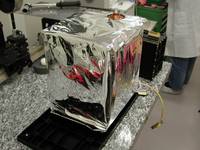
This compact instrument – with a mass of 31 kilograms and about the size of a TV set – has two separate channels: one for short wave infrared, another for thermal infrared detection. Radiation beams are directed to these channels with a specially engineered mirror.
|
"PFS works much more precisely than the most finely made Swiss watch", says Vittorio Formisano. |
Altogether PFS covers the widest infrared range of any instrument ever to orbit Mars or the Earth, the wavelengths stretching from 1.2 up to 5 microns and from 5 to 45 microns (millionth of a metre).
Many molecular species leave characteristic sets of absorption or emission features or ‘fingerprints’ within the infrared spectrum. The challenge for the designers of PFS was to achieve sufficient spectral resolution to detect these features within a small enough package to be sent to Mars.
"PFS works much more precisely than the most finely made Swiss watch," says Vittorio Formisano, Principal Investigator for the instrument. "It is certainly extremely precise in terms of its motion and synchronisation of actions, but this synchronisation has got to be not just mechanical but also optical, electronic and computational."
 |
|
|
PFS – Module O |
PFS does not rely on a direct means of splitting the Martian radiation into its spectrum of individual wavelengths, such as a prism or grating. Instead PFS is based around an optical occurrence called interference, where overlapping light waves interact with each other to either increase or decrease their combined intensity. Depending on the effect, this interference is termed either ‘constructive’ or ‘destructive’.
The same interference phenomenon is seen in ocean swells; when opposing waves meet on the sea their heights may combine together to produce a single higher wave, or they may cancel each other out to leave calmer waters. This depends on whether or not their wave peaks and troughs are synchronised, usually called being ‘in phase’. Most often the overlapping waves form mixed constructive and destructive swells known as ‘interference patterns’.
The optical system in PFS – with its long-wave and short-wave infrared channels working in parallel – is set up first to divide the beam of Martian radiation entering its given channel, then to recombine it in such a way that the phase of the component beams keeps shifting. This sets up interference ‘fringes’ of shifting light that are recorded by a photodetector.
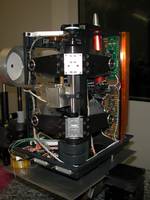
The process begins when the radiation encounters a half-mirrored beam splitter set up at 45 degrees to it. The beam splitter divides the radiation into two identical halves, which proceed at a 90-degree angle away from one another. These two beams then meet mirrored corner cubes that are not like normal mirrors: they are designed to reflect light back in the exact same direction that it came from.
 |
|
|
Interferometer closeup view |
These corner cubes are not at rest but are in motion, set on the end of a double pendulum rotated by a motor. There are actually two double pendulums for the two infrared channels fixed to the same axis, with one resting on top of the other.
Each double pendulum moves so that the total length travelled by the pair of light beams becomes progressively more unequal. This difference in distance causes the twin beams – which have now been reflected back to meet each other – to move in and out of phase with each other. In turn this induces alternating patterns of constructive and destructive interference through the duration of a single measurement cycle – causing these ripple-like interference fringes.
This difference between the there-and-back again distance these twin beams end up travelling is termed their ‘optical path difference’. The maximum optical path difference achievable by the instrument is actually what determines its total spectral resolution.
With PFS the double pendulum rotates through a combined distance of five millimetres through the entire range of possible optical path differences. Some 16 384 separate intensity samplings are made in four seconds. It takes another six seconds to complete the measurement cycle by sending the results to the PFS electronics module to prepare for their despatch to Earth. Each sampling represents an optical path difference of 0.6 microns, corresponding to an actual physical displacement of the corner cube mirrors by 150 nanometres. Of course each time a mirror is moved this distance the beam has to travel there and back again, meaning twice that length. With two mirrors being moved at a time the total comes to 150 nanometres multiplied by four.
For accuracy it is vital to keep the accuracy rate constant and this is achieved with a laser diode whose light shines in parallel through the same optical channels as the sampled radiation. Unlike the broadband or multiple-wavelength Martian radiation, this laser light is monochromatic, which means it possesses a single fixed wavelength and, therefore, frequency. This means it can be used to time the sampling rate and control the motion of the double pendulum.
|
"The PFS is a powerful but extremely delicate instrument," Formisano adds. "Mechanical deformations as small as a micron – less than the width of a bacteria – can wreck the experiment completely." |
The Martian radiation contains a continuum of wavelengths, each one of which gives rise to a different interference pattern across the entirety of the mirrored corner cube motion. What PFS actually returns to Earth is the overall interference pattern or ‘interferogram’ as measured by the detector, a summary of all the interferences from the various infrared wavelengths.
This interferogram is not in itself the Martian infrared spectrum, but it does have information on the total range of wavelengths ‘encoded’ within it. The application of a powerful mathematical tool called the Fast Fourier Transform – used across a wide array of fields including Magnetic Resonance Imaging in medicine – enables the retrieval of this spectral information.
"The PFS is a powerful but extremely delicate instrument," Formisano adds. "Mechanical deformations as small as a micron – less than the width of a bacteria – can wreck the experiment completely. At the same time the instrument has to be robust enough to survive the launching phase vibrations."
The unique reflective properties of the corner cubes mean that even if the instrument is tilted the light beams continue to propagate in precisely the same direction as before.
 |
|
|
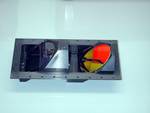
Entrance group detail |
PFS currently carries out around 300 measurements per martian orbit, its activities concentrated around the hour and a half when the Mars Express spacecraft is at its closest to the planet. From an altitude of 300 km the short wavelength channel has a 1.6 degree field of view, while the long wavelength channel has a 2.8 degree field of view, equivalent to spatial resolutions of seven km and 14 km respectively.
One advantage of its design, compared to other types of spectrometers, is that the PFS observes the entire spectrum at all times and its overall signal-to-noise ratio can be improved simply by increasing the total number of observations. Since Mars Express reached orbit some 105 000 measurements have been carried out, a number that is constantly growing.
There are Earth-based spectrometers with higher spectral resolution but none possessing such a wide sampling range across almost all the infrared wavelengths. Plus, instruments on Earth have to contend with the terrestrial atmosphere being between them and Mars, making precise measurements of trace gases very difficult.
Of course, positioned millions of kilometres from Earth, the PFS instrument has to be self-calibrating. This is done by having PFS recalibrate itself between observations by making a comparison to a cylindrical ‘black body’ at spacecraft temperature and the cold emptiness of deep space.