Methane on Mars
|
20 May 2005
|
|||||||||||||
Methane on Mars
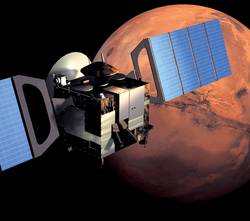
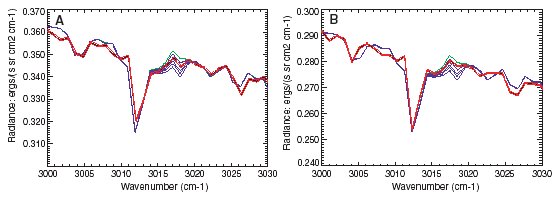
The PFS on board ESA’s Mars Express spacecraft has detected methane on Mars. Methane is a possible ‘biomarker’ of extinct or present life on Mars. However, this methane could also have an ‘abiotic’, or non-biological, origin. The PFS returned a spectrum that was compared to the synthetic models for assumed Martian conditions – see the graph at the bottom of this article. The observations correspond to approximately 10–15 parts per billion of methane (ppb). Considering the statistical uncertainty in the results, a conservative methane mixing ratio would be 10±5 ppb. Previously, an upper limit of 20 ppb of methane was obtained by NASA’s Mariner 9, and 70±50 ppb from the ground. However, two ground-based detections of methane were reported recently, one with unknown abundance and the other with 11±4 ppb, in agreement with the PFS result for the global methane value reported here. Methane on Mars could have several possible sources. On Earth, the main source of methane is predominantly biological, and this is one possibility on Mars as well. The other possibilities include methane delivered by the influx of meteorites and comets, release of any methane stored in subsurface reservoirs, or outgassing from localised geothermal/hydrothermal hotspots. We have made estimates of the strength that these various sources would have to be to produce the observed abundance of methane. This observed global average value of 10 ppb corresponds to a column abundance of 2.2 × 10⁻¹⁵ cm-2 methane molecules at the surface of Mars. Assuming a methane photochemical lifetime of about 2 × 10¹⁰ seconds near the surface, we estimated that about 1 × 10⁵ molecules cm-2 sec-1 would be required to explain the methane mixing ratio of 10 ppb on Mars. Over the whole planet, this means that the source would have to produce about 4 g sec-1 or about 126 metric tons per year of methane.
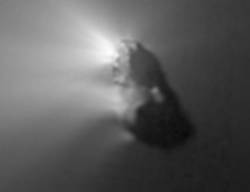
Comets are potentially the largest source of methane not originating on Mars. Observations of eight Oort cloud comets show that the methane/water mixing ratio lies in 0.15-1.5% range, with most comets showing greater than 0.5% and one as high as 2.3%. For our present estimate, we assume a cometary amount of methane of 1%, and that most of the mass of the comet is water ice. Taking an average impact rate of 1.6 × 10⁻⁸ ton per year for the ecliptic comets and a typical cometary radius of 1 kilometre, the amount of methane delivered to Mars by comets would be of the order of 1 ton per year on average. This is less than 1% of that needed to maintain the steady state mixing ratio of 10 ppb of methane on Mars. Since the ‘lifetime of methane’ is only a few hundred years (it oxidises in the Martian atmosphere), the ‘average’ amount from comets is not a very meaningful quantity. Next, we therefore consider the possibility that the methane on Mars is constantly declining, and that the quantity measured today may simply be a relic of a cometary impact that occurred in the past, several hundreds or thousands of years ago. To supply enough methane so that 10 ppb methane remains today, we calculate that this requires an impact by a comet of radius 140 metres about 100 years ago, 160 metres 500 years ago or 220 metres 1000 years ago, etc. It is not presently known whether a single event of this type did actually take place, but it appears promising enough to warrant additional investigation. But if comets are the source of methane on Mars, then the event must be relatively recent.
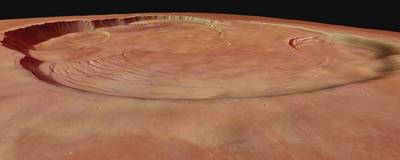
On the other hand, methane could have been formed by volcanic processes, or stored in methane hydrates for later release to the atmosphere. Volcanoes on Earth are not a big source of methane, and large-scale volcanism has not taken place on Mars for over 100 million years. However, small-scale outgassing of methane cannot be ruled out. But probably a larger source lies in the possible alteration of Martian basalt at temperatures below 150°C, a process that results also in the conversion of original carbon dioxide (CO2) into methane in a subpermafrost aquifer. Chemical equilibrium computer models show that as much as 0.2 bar, or about 1015 tons, of methane could have been produced if the only source of carbon in this region was the CO2 initially present in the crustal pores. Methane could have been held in stable methane hydrates and gradually risen to the planet’s surface. The rate of release to the atmosphere is unknown, but if we assume that leaking has been taking place at a uniform rate over geological time, it would amount to about 200 000 tons per year. This is much greater than the one hundred tons or so per year needed to maintain the 10 ppb on Mars today. Even if methane from the hydrate is being released at a rate of 1000 times slower, it would still be sufficient to account for the observations. Much geophysical modeling is needed to understand these processes fully. Finally, recent laboratory experiments confirm non-biological generation of methane is possible in mineral-catalysed hydrothermal reactions of CO2 and water at 390°C and 400 bar, conditions that are likely to be encountered in subpermafrost aquifers or deep under the Martian polar ice. Moreover, the catalysts used in the experiment – iron and chromium oxides – are also believed to be present in the Martian rocks. If the source is biogenic (of biological origin) and current, then ‘methanogens’ that use carbon monoxide (CO) or hydrogen for energy are good candidates. Methanogens are single-cell methane-producing organisms, originally thought to be bacteria but now recognised as belonging to a separate classification, the ‘archaea’. On Earth, they are most numerous in anerobic (lacking oxygen) freshwater environments, such as lake sediments and the digestive tracts of animals. Ecosystems of ‘chemolithotrophic’ microbes are common deep under Earth’s surface, and they release methane and water as a product of metabolism. It is possible that one or several microbial colonies may exist in the subpermafrost aquifer environment of Mars, where microorganisms utilise the Martian CO and hydrogen, and produce methane in turn. The Martian atmosphere provides a ready source of CO (about 700 ppm) and hydrogen (40-50 ppm based on models and observations). These gases are expected to diffuse through the regolith to the subsurface aquifers. It has been suggested that the source of methane need not be current. If microorganisms existed on Mars only in the past during its (possible) warm and wet phase and produced methane, that methane could have been stored in methane hydrates for later release as discussed earlier. A comparison of the methane source strength on Mars (4 g sec-1) with that on Earth (1.67 × 10⁷ g sec-1) indicates that if methane on Mars is microbial in origin, the microbe population must be tiny. This is because nearly all of the 1700 ppb of methane in Earth’s atmosphere has its ultimate origin in living things, and the Martian source pales in comparison. It is important to point out that if microorganisms are or were present on Mars, the subpermafrost region is the most likely place to find them, as the presence of hydrogen peroxide, ultraviolet radiation and the low temperature and pressure on the surface of Mars makes it hostile to life as we know it. Finally, the relatively long lifetime of methane implies that, except over any localised sources, its distribution is expected to be uniform over the planet once steady state is reached. On the other hand, diffusion of methane through the regolith into the interior of Mars is a distinct possibility. If the process is more efficient than the time it takes for methane to become uniform (a few weeks or faster in the Martian atmosphere), then the surface loss could result in a non-uniform distribution of methane on Mars. If the local surface sink, e.g. due to varying mineralogy, is not as rapid, a cometary source for methane on Mars would be less viable. PFS also found a variability of methane abundance at different longitudes over the planet. This variation could represent either spatial or temporal changes. If there are spatial variations, it might be possible to eventually locate the source. Although we do not presently have sufficient information to differentiate between the various possibilities, we can attempt to determine whether the variations are random in time or in space. Additional work and more data are needed to be able to map the methane mixing ratio distribution not only for specific longitudes but also in latitude. In summary, we want to stress that the detection of methane does not imply presence of life on Mars, now or in the past. It is one possibility, but, as shown above, other sources are equally likely and could be even more potent.
|